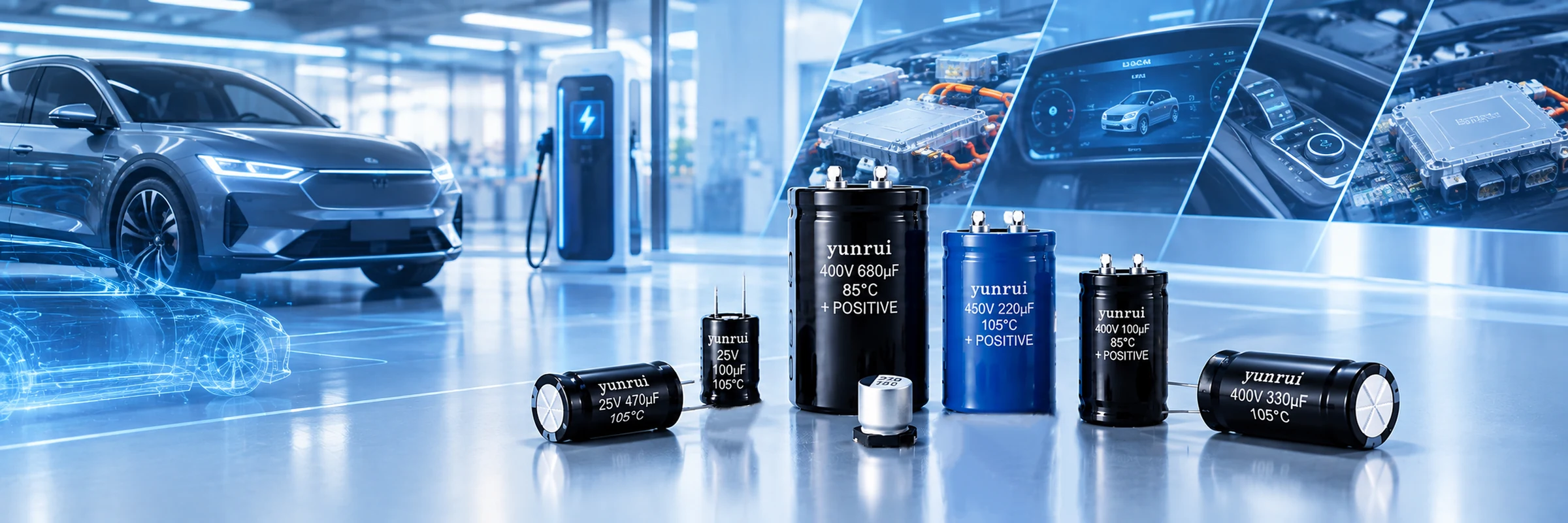
Application Sector
Capacitor Solutions for Automotive Electronics
Vehicle electronic modules combine DC power distribution, conversion and control in one enclosure, and most of them stay powered or wake frequently even when the vehicle is parked. Typical capacitor positions are the input stage of on-board DC-DC converters, smoothed internal supply rails and the filtering inside battery-related modules.
Two characteristics dominate those positions: how the part behaves across a wide temperature range over many years, and how much leakage current it draws on rails that are effectively always connected.
Yunrui does not claim automotive qualification or certification for the products referenced on this page, and no automotive standard or product grading is implied. For automotive-electronics projects, qualification and documentation requirements should be verified for the specific project before selection.
Design challenges
Application Challenges in Automotive Electronics
Five aspects decide whether a capacitor survives in vehicle electronics.
Temperature range and cycling
Vehicle electronics see cold starts and high soak temperatures, repeatedly, for years. Look at the temperature range together with how often it is traversed.
Always-on rails
Modules that keep quiescent current low are sensitive to capacitor leakage. Leakage behaviour should be reviewed as a design parameter and not treated as a datasheet footnote.
Battery-related modules
Electronics attached to a battery pack have both a wide supply range and long standby periods, which together make leakage and endurance relevant at the same time.
Long service expectation
Vehicle electronic modules are expected to last for years without service, so endurance has to be judged against the targeted vehicle lifetime rather than a bench test.
Space and mechanical constraints
Module housings are compact, and through-hole parts need mechanical support in vibration environments; the PCB layout should be reviewed with that in mind.
Selection dimensions
Capacitor Requirements for Automotive Electronics
Vehicular duty pushes on three parameters more than anything else: temperature, leakage and endurance. The other three still have to be checked.
Operating temperature range
Check the full range including cold-start behaviour, not just the upper limit, and confirm the range against where the module is physically installed in the vehicle.
Low leakage current
Where a rail is permanently connected, review the leakage specification explicitly; the RX Series below is listed in the catalogue specifically for low leakage.
Rated voltage with margin
Size the rating against the supply including its variation, rather than against the nominal value only.
Endurance at working temperature
Compare endurance with the target lifetime of the module and with the temperature the part will actually run at.
ESR and impedance behaviour
For DC-DC input and output positions, check how ESR and impedance behave over the temperature range, since converters see the worst values at cold start.
Mounting format
Through-hole radial or surface-mount, plus lead and pad support for the mechanical environment of the installation point.
Layer A and B
Recommended Product Types
Recommendations below are given on two levels. Where the catalogue itself states a relevant use, the series is named and the statement is quoted; otherwise only the product type is given.
Conductive polymer aluminum solid capacitors
Used where low ESR, low leakage and stable behaviour over temperature matter in low-voltage module rails. Available in radial construction within this family.
Low leakage current capacitors
A dedicated product position inside the conductive polymer family for circuits where leakage current is a design constraint rather than a secondary figure.
Relevant series
Three series are listed. One is named by the catalogue for in-car use, the other two on the basis of verified characteristics, with the limits of that basis stated.
RX Series
The catalogue states this series for mobile power banks, battery management modules or in car applications. That statement is the entire basis for listing it here, and no additional automotive claim is made.
RH Series
Verified for operation to +125 degC, and described in the catalogue as suited to increasing device reliability. Listed for high local temperatures; automotive suitability has to be confirmed per project.
RS Series
The catalogue names this series for DC-DC converters and voltage regulators. May be considered where a module contains those circuit stages, depending on circuit requirements.
Nothing above implies automotive qualification, AEC status or any industry grading. Those labels do not appear in our documentation for these products, so they are deliberately not used here.
No automotive qualification or certification is claimed anywhere on this page. Ask us for the documentation that is actually available for the part before freezing the design.
Circuit positions
Typical Use Cases
Representative circuit positions inside vehicle electronic modules, described as positions rather than projects.
Input stage of on-board DC-DC converters
Where ripple current and cold-start ESR behaviour both matter.
Internal supply rails of control modules
Smoothed low-voltage rails feeding logic and driver stages inside the module.
Battery management related electronics
Electronics attached to the battery for monitoring and balancing, where the RX Series statement above applies.
Always-on standby or sensing paths
Permanently connected rails where leakage current is part of the power budget.
Locations with higher local temperature
Positions near heat sources inside the vehicle, where a series verified for operation to +125 degC may be considered.
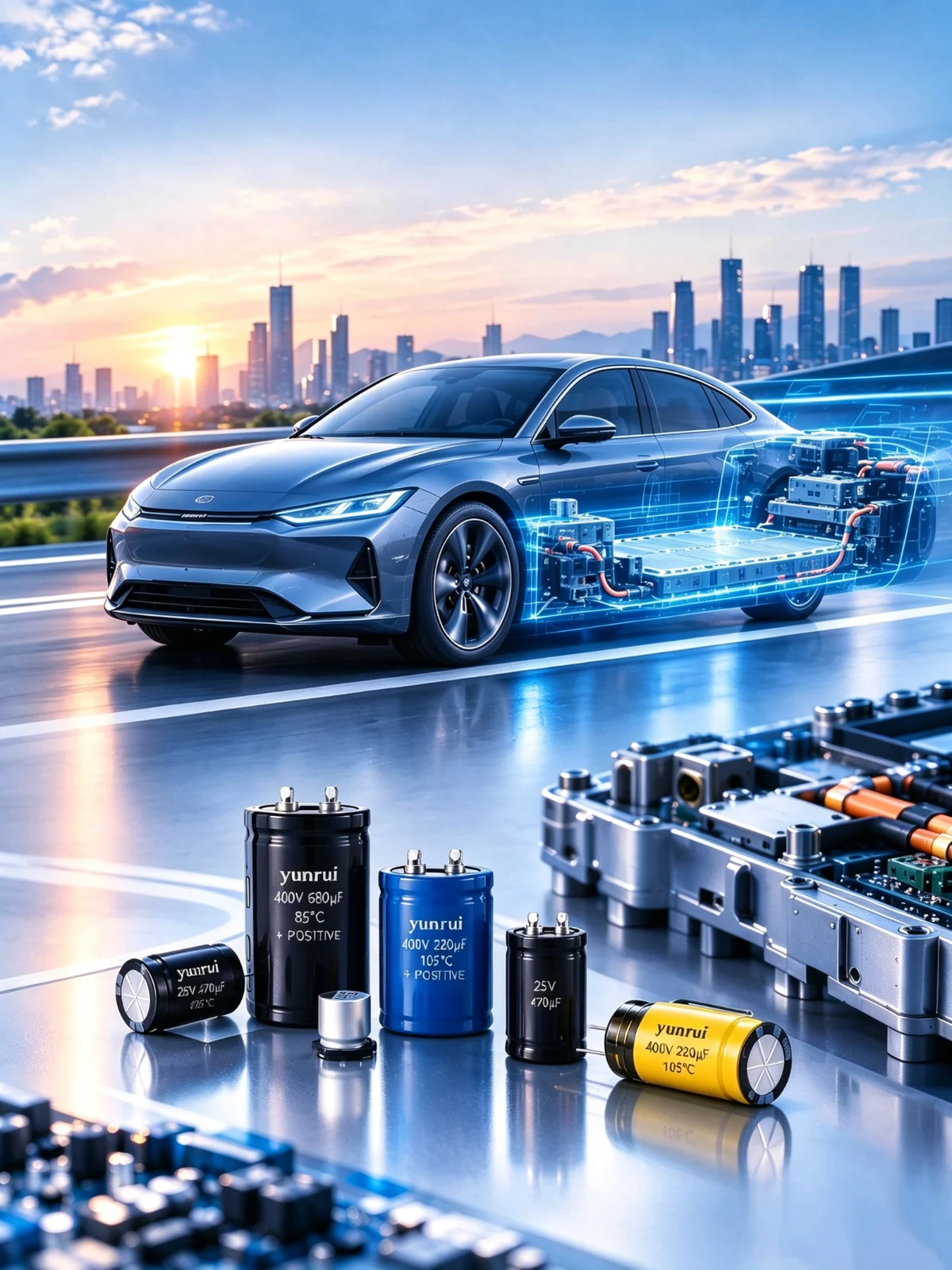
Capacitor positions in automotive electronic modules
Where the capacitors sit
Three positions that decide the part
Automotive electronic modules keep several capacitor positions under continuous electrical duty. The requirement changes with the position rather than with the vehicle type.
01 — DC-DC input stage
Handles the incoming rail and its ripple before conversion, so ripple current capability is the limiting parameter rather than nominal capacitance alone.
02 — Smoothed internal supply rails
Sits behind regulation and carries a smaller ripple load, but stays energised for the whole service life of the module.
03 — Battery-related module filtering
Remains connected while the vehicle is parked, which is why leakage current and long-term stability matter as much as capacitance.
Yunrui does not claim automotive qualification or certification for the products referenced on this page. Qualification and documentation requirements should be verified for the specific project before selection.
Engineering checklist
Selection and Reliability Considerations
What to check before shortlisting a capacitor for this equipment class.
- State the required qualification and documentation package before selecting parts, and verify it for the specific project rather than assuming it exists.
- Check leakage current explicitly on every rail that stays connected when the vehicle is parked.
- Review ESR and impedance at the lowest expected start temperature as well as at the highest operating temperature.
- Compare endurance at real operating temperature with the target module lifetime.
- Review mechanical support of leads and pads with the installation point in mind.
- Final capacitor selection should be confirmed against the specific electrical, thermal and mechanical requirements of the application.
Next step
Relevant Products and Series
Published links into the product structure. Every link below goes to a live page.
Relevant product families
Relevant categories
Request for quotation
Need help selecting a capacitor for your application?
Tell us what the circuit actually needs and we will answer with comparable part options rather than a generic brochure.
- Application and equipment type
- Working voltage including excursions
- Required capacitance and ripple current
- Operating temperature at the capacitor position
- Required lifetime or service interval
- Mounting and board-space constraints
Guizhou Yunrui Electronic Technology Co., Ltd. was established in 2018 and operates a 68,000 m2 production facility with 300+ production lines, more than 4,000 product models, 25 intellectual property rights and a supply capacity of approximately 15 million pieces per day, under ISO 9001 and ISO 14001 certified systems.