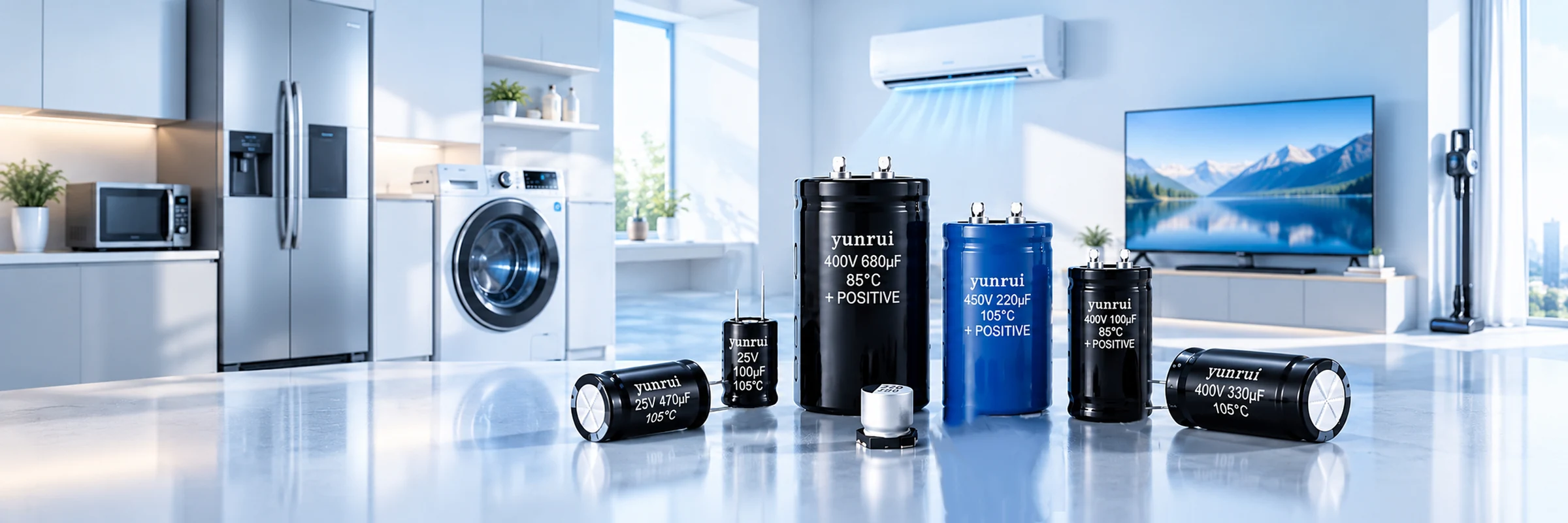
Application Sector
Capacitor Solutions for Household Appliances
Behind the front panel of a modern appliance sits a control board that carries the auxiliary supply, the relay and driver stages, sensing and the user interface. Some designs also include inverter-driven motor electronics for compressors and drum drives.
Capacitors on these boards work in the mains-derived auxiliary supply, across its DC rails and in the filtering around the control electronics. The electrical stress is usually moderate, but the duty profile is not: appliances switch on and off thousands of times and are expected to keep working for years without service.
For this sector the catalogue does not assign any specific series to appliance applications, so the mapping below is deliberately kept at product-type level. Series selection should follow from the actual control board requirements.
Design challenges
Application Challenges in Household Appliances
Appliance control boards combine four recurring pressures.
Repeated heating cycles
Every operating cycle heats the board and every idle period cools it. Reviewing endurance together with the expected number of operating cycles is more relevant than looking at either alone.
Heat from nearby mechanical parts
Control boards are often mounted close to motors, compressors, heating elements or airflow paths. Local board temperature, not ambient room temperature, decides what the capacitor sees.
Flat and high-density board layouts
Appliance control boards are cost-optimised and often single-sided with height limits. Component height and lead pitch are frequently harder constraints than electrical ones.
Cost targets against long expected service life
Appliance designs are priced aggressively while still expected to last for years, so the balance between endurance and unit cost has to be made explicitly.
Selection dimensions
Capacitor Requirements for Household Appliances
Appliance duty is less about peak stress and more about repetition. These dimensions matter most.
Auxiliary supply voltage
Size the rating for the mains-derived DC rail, including how the supply behaves at high and low mains and during switch-on.
Capacitance on the DC rail
Value follows the ripple and hold-up requirement of the auxiliary supply and the transient loads from relays and drivers.
Board temperature
Derive the requirement from the measured board temperature in the installed position, especially where the board sits near a heat source.
Endurance under cycling
Check the endurance figure and how it relates to continuous versus intermittent duty, and compare it with the intended service life of the appliance.
Leakage current behaviour
Where a rail is always live or a sensing circuit is high-impedance, review leakage current behaviour including after long idle periods.
Mounting format
Radial through-hole parts remain common on appliance boards; surface-mount versions suit automated assembly and low-profile designs, with variants specified for higher operating temperatures.
Layer A and B
Recommended Product Types
The Yunrui catalogue does not state household-appliance applications for any specific series, so only product types are recommended here. Naming series anyway would be guesswork, and this page intentionally stops where the evidence stops.
Radial electrolytic capacitors
The standard choice for appliance control boards assembled with through-hole technology, covering smoothing and filtering positions on the auxiliary supply.
SMD electrolytic capacitors
For boards built with surface-mount assembly, covering the same functional positions in a lower profile.
SMD (PET sleeve) electrolytic capacitors
A PET-sleeved surface-mount construction; this family also includes variants specified for operation to 130 degC, which matters when the board sits near a heat source.
No series is named for this sector: no series page in the catalogue states household appliance use. Send us the board requirements and we will propose specific parts.
Circuit positions
Typical Use Cases
Typical circuit positions where these capacitor types are evaluated on appliance control boards.
Auxiliary power supply stage
Smoothing and filtering in the mains-derived low-voltage supply that feeds the whole control board.
DC rails feeding logic and driver stages
Decoupling of the rails supplying the controller, relays and gate or driver circuits, where load steps are frequent.
Motor-drive related power electronics
Power stages of inverter-driven compressor or drum designs, where ripple current and temperature come together.
User interface and display boards
Low-duty electronics separated physically from the power stage, where low profile often drives the choice.
Standby and sensing rails
Always-live rails where leakage behaviour and long idle periods should be reviewed.
Engineering checklist
Selection and Reliability Considerations
What to check before shortlisting a capacitor for this equipment class.
- Measure board temperature in the installed position before choosing a temperature class.
- Decide how many operating cycles the appliance is designed for, and compare that with the endurance figure quoted for the part.
- Check the height of the tallest part against the enclosure or cover before locking the layout.
- Where a rail never switches off, review leakage current rather than assuming it is negligible.
- Confirm assembly method first: through-hole and surface-mount versions are not interchangeable on the same footprint.
- Final capacitor selection should be confirmed against the specific electrical, thermal and mechanical requirements of the application.
Next step
Relevant Products and Series
Published links into the product structure. Every link below goes to a live page.
Relevant product families
Relevant categories
Selected series
- No series is named for this sector: the catalogue does not state this application for any series. Series selection follows from your circuit requirements.
Request for quotation
Need help selecting a capacitor for your application?
Tell us what the circuit actually needs and we will answer with comparable part options rather than a generic brochure.
- Application and equipment type
- Working voltage including excursions
- Required capacitance and ripple current
- Operating temperature at the capacitor position
- Required lifetime or service interval
- Mounting and board-space constraints
Guizhou Yunrui Electronic Technology Co., Ltd. was established in 2018 and operates a 68,000 m2 production facility with 300+ production lines, more than 4,000 product models, 25 intellectual property rights and a supply capacity of approximately 15 million pieces per day, under ISO 9001 and ISO 14001 certified systems.