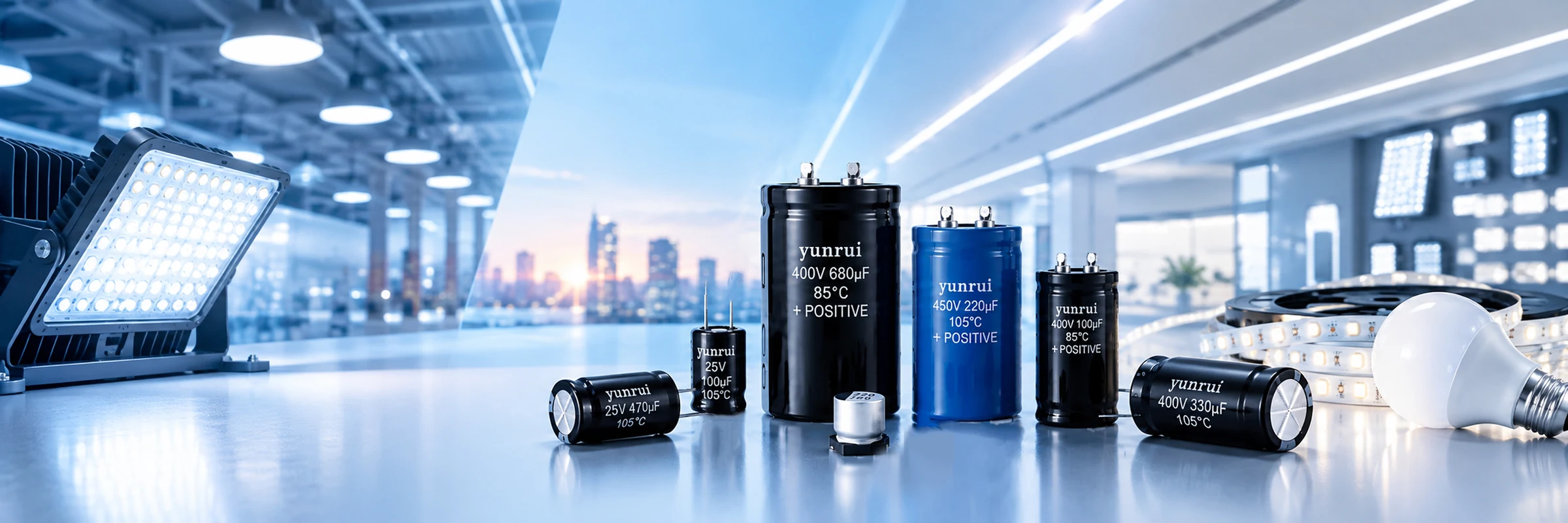
Application Sector
Capacitor Solutions for LED Lighting
An LED luminaire is a power-electronics product before it is a light source. The driver takes mains or DC input, converts it in a switch-mode stage and delivers controlled current to the LED string, and it usually has to do that inside a compact, often sealed enclosure for many thousands of hours.
In those stages capacitors handle input smoothing after the rectifier, intermediate filtering and output decoupling. Their temperature behaviour and ripple-current capability are usually among the first things that decide how long the driver survives, so the choice should be made from the driver design, not from the part number alone.
Yunrui manufactures aluminum electrolytic capacitors and conductive polymer aluminum solid capacitors. Which type, series and can size is appropriate depends on topology, ripple current, enclosure temperature and the service life the luminaire has to reach.
Design challenges
Application Challenges in LED Lighting
Four design pressures dominate capacitor selection in LED driver and ballast work.
Long operating hours
Commercial and industrial fixtures run for extended daily duty cycles, and the occupancy sensors rarely switch a whole building off. Endurance at temperature is therefore one of the first parameters to check against the expected service life, not an afterthought.
Heat inside compact enclosures
Driver housings are small, frequently sealed, and often mounted close to the LED board heat sink. Reviewing the operating temperature against the hottest point in the assembly is more useful than reviewing it against room temperature.
Ripple current in the driver stage
Bulk and output positions see continuous ripple. A capacitor operated beyond its ripple capability heats internally, which shortens life independently of the ambient conditions around it.
Space and assembly constraints
Slim linear drivers restrict can height, and downlight drivers restrict diameter. Dimensional availability often eliminates options before electrical parameters do.
Selection dimensions
Capacitor Requirements for LED Lighting
Translate the driver design into these six selection dimensions before looking at individual series.
Operating temperature
Start from the measured or simulated worst-case temperature inside the housing, then check the series temperature range with margin for seasonal and installation variation.
Rated voltage
Size the rating against the working DC voltage plus ripple peaks, with margin for mains variation and, where relevant, for surge behaviour at switch-on.
Capacitance
Set the value from the hold-up and ripple requirement of the stage. Bigger is not automatically better: it changes inrush behaviour and enclosure volume.
Endurance / load life
Compare the endurance figure with the intended service profile of the luminaire. Endurance is quoted at a specific temperature, so compare like with like.
Ripple current and ESR
Check the ripple rating in the actual position, and remember low ESR shifts ripple distribution when several capacitors share a rail.
Mounting format
Radial leaded parts suit through-hole driver boards; surface-mount formats suit automated assembly and very flat enclosures. Lead spacing and height must match the PCB layout.
Layer A and B
Recommended Product Types
Recommendations below are given on two levels. Product types are what the catalogue supports generally; individual series are named only where the catalogue itself states the corresponding application.
Radial electrolytic capacitors
The through-hole radial format is the common choice for LED driver boards where board area allows leads, because can sizes suitable for bulk and output positions are available across a wide voltage spread.
SMD (PET sleeve) electrolytic capacitors
Where the driver board is assembled automatically or the enclosure is very flat, surface-mount versions cover the same functional position in a lower profile.
Relevant series
The four series below are named for LED-related applications in the Yunrui catalogue. They are listed because that statement exists, not because they are the only parts that can be used.
GH Series
Listed for LED lighting, electronic ballast and energy-saving lamp applications; characterised in the catalogue by high ripple current, high-temperature operation and long life.
GE Series
Same catalogue application statement as the GH Series, with a longer endurance figure at 105 degC, suited to fixtures where maintenance access is expensive.
CD11-115 Series
Carries the same LED driver application statement and is specified for operation to 115 degC, useful where the driver sits above the usual 105 degC boundary.
CD11-130 Series
Carries the same LED driver application statement and is specified for operation to 130 degC for high-temperature location designs.
The GE and CD11-130 series also exist as SMD (PET sleeve) versions, whose catalogue pages describe them for high-density surface mounting rather than repeating the LED statement. They are therefore not listed here as LED series.
Circuit positions
Typical Use Cases
Typical circuit positions where these capacitors are evaluated in lighting equipment. These describe positions, not customer projects.
Driver input stage
Smoothing after the rectifier, where bulk capacitance and mains variation margin are the deciding factors.
Constant-current driver output
Filtering of the stage feeding the LED string, where ripple current directly affects internal heating.
Electronic ballast circuits
Resonant and supply positions inside electronic ballast topologies.
Luminaire-integrated driver modules
Detachable or integrated driver PCBs that have their own thermal environment inside the fixture housing.
Auxiliary supply rails in the luminaire
Low-voltage rails feeding control, sensing and dimming interface electronics inside smarter fixtures.
Engineering checklist
Selection and Reliability Considerations
What to check before shortlisting a capacitor for this equipment class.
- Confirm the worst-case ambient temperature at the capacitor location, not at the room.
- Check whether the endurance figure you are comparing is quoted at the temperature your design actually runs at.
- Verify the ripple current rating for the exact position and check how ripple is shared when multiple capacitors sit on the same rail.
- Check the full inserted height and diameter against the enclosure before freezing the PCB layout.
- Review surge and switch-on behaviour where the fixture is switched frequently.
- Final capacitor selection should be confirmed against the specific electrical, thermal and mechanical requirements of the application.
Next step
Relevant Products and Series
Published links into the product structure. Every link below goes to a live page.
Relevant product families
Relevant categories
Request for quotation
Need help selecting a capacitor for your application?
Tell us what the circuit actually needs and we will answer with comparable part options rather than a generic brochure.
- Application and equipment type
- Working voltage including excursions
- Required capacitance and ripple current
- Operating temperature at the capacitor position
- Required lifetime or service interval
- Mounting and board-space constraints
Guizhou Yunrui Electronic Technology Co., Ltd. was established in 2018 and operates a 68,000 m2 production facility with 300+ production lines, more than 4,000 product models, 25 intellectual property rights and a supply capacity of approximately 15 million pieces per day, under ISO 9001 and ISO 14001 certified systems.
Relevant products
Capacitors listed for LED lighting
The two series below are named for LED lighting duty in the Yunrui catalogue. The photographs are the manufacturer's own product images.
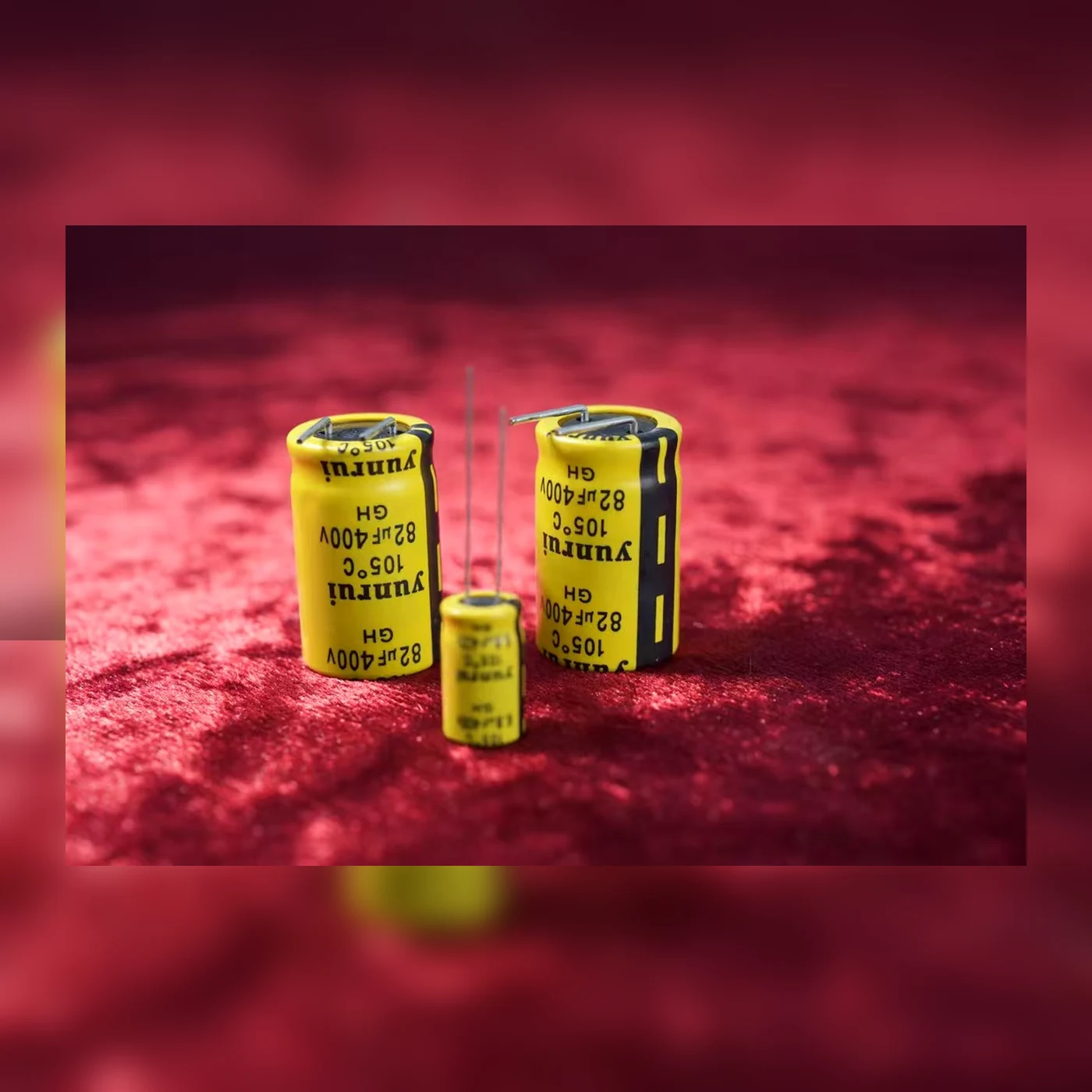
GH Series
GH Series — 82 microfarad, 400 V DC, 105 degrees Celsius radial type
Listed for LED lighting drive circuits in the Yunrui catalogue.
View series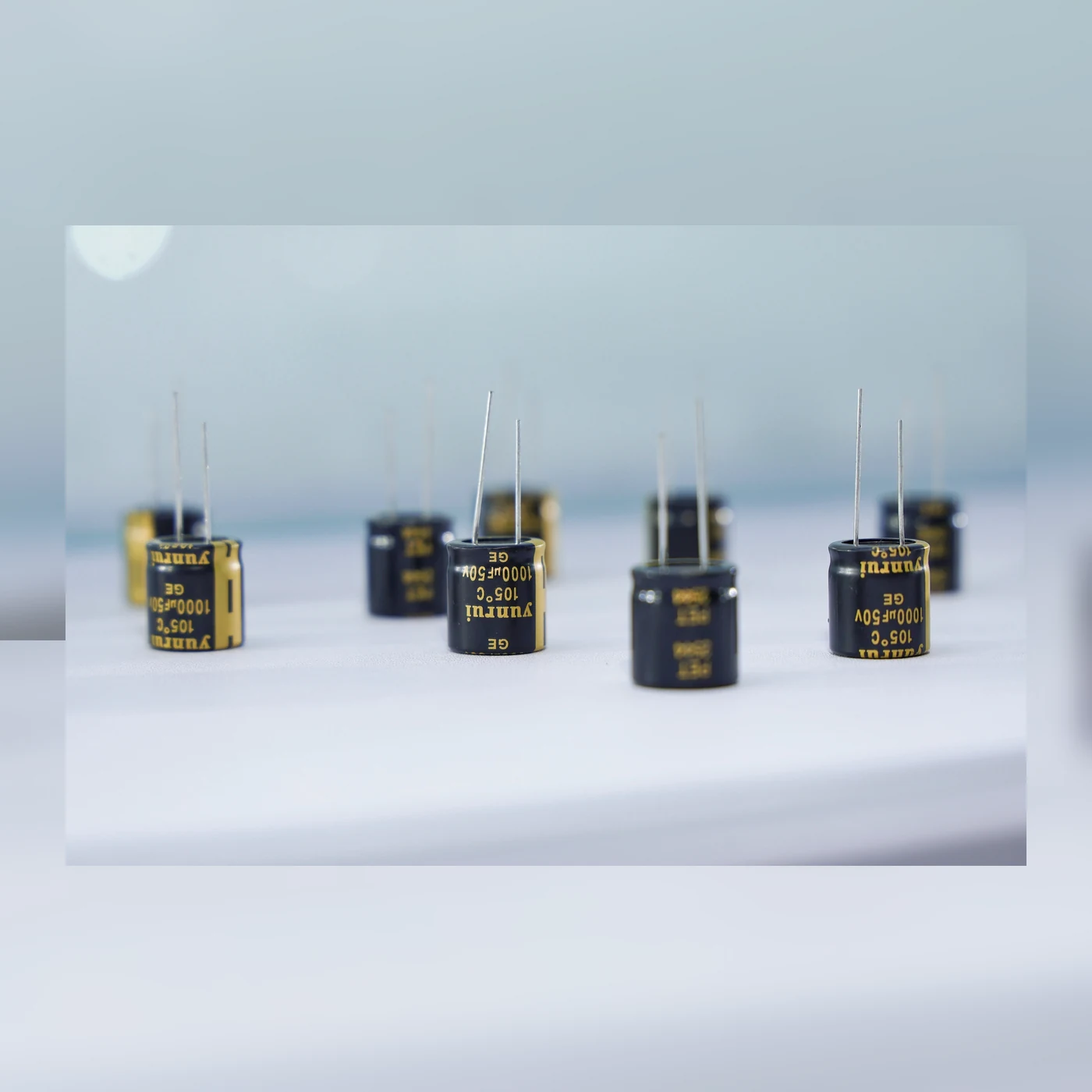
GE Series (radial)
GE Series — 1000 microfarad, 50 V DC, 105 degrees Celsius radial type
Listed for LED lighting drive circuits in the Yunrui catalogue.
View series