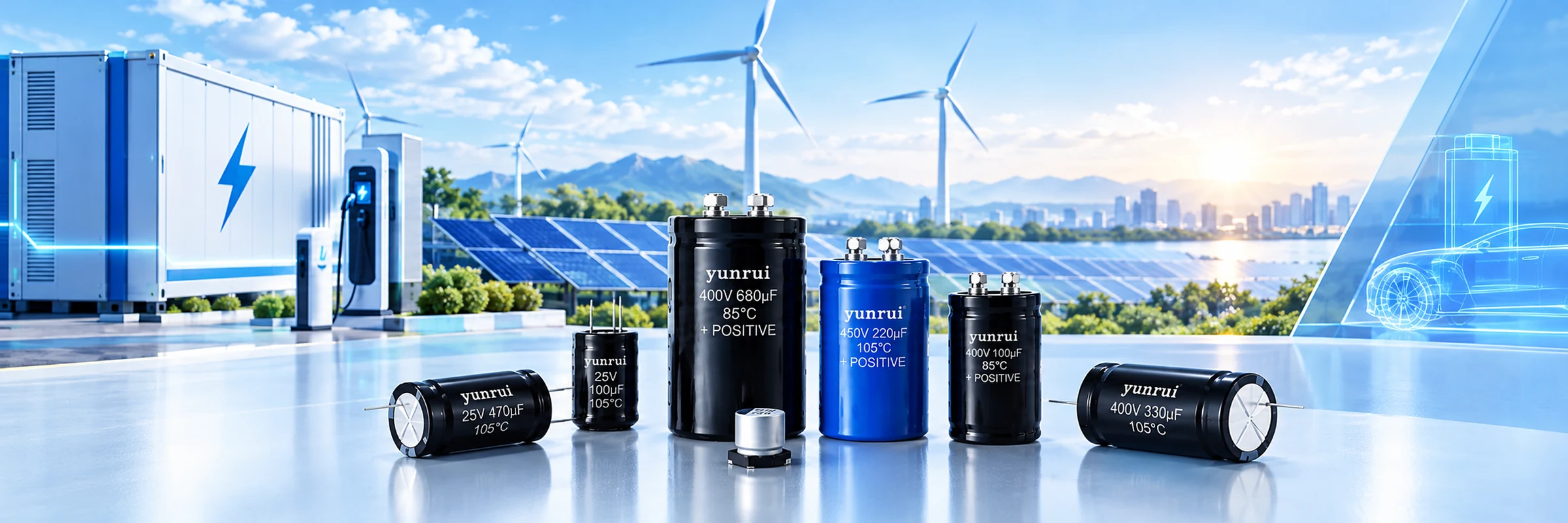
Application Sector
Capacitor Solutions for New Energy Equipment
New energy equipment converts electrical energy from one form to another. String and central inverters take a DC source and generate grid-synchronised AC, conversion stages move power between different DC levels, and conversion cabinets also carry their own auxiliary supplies and control electronics.
The capacitor positions that decide service life are the DC bus ones, where high working voltage, continuous ripple current and elevated internal temperatures arrive together, and the low-voltage electronics attached to battery systems, where leakage current matters more.
The Yunrui catalogue does not state solar, wind or storage certification for any product, and none is claimed here. The series below are listed because the catalogue names them for inverter, switching power supply, large power source and frequency converter circuits, and because one series is named for battery management modules.
Design challenges
Application Challenges in New Energy
Energy conversion equipment combines electrical and environmental stress over a long service period.
High DC bus voltage
Conversion stages work from DC buses at voltages where rating margin, and sometimes bank arrangements, have to be designed rather than assumed.
Continuous conversion ripple
Bus capacitors absorb ripple for as long as the plant generates or stores energy, which makes internal heating a life-limiting factor.
Thermal cycling and enclosure temperature
Outdoor and semi-outdoor enclosures cycle daily and seasonally, so temperature range and cycling behaviour matter as much as the peak value.
Long expected service interval
Generation and storage assets are planned over many years, so endurance should be compared with the plant's own service planning.
Selection dimensions
Capacitor Requirements for New Energy
Six dimensions decide the shortlist for bus positions and control electronics alike.
Rated voltage and margin
Establish the bus working voltage including its excursions, then decide whether the rating is achieved with one part or a bank.
Capacitance for the bus
Value follows bus ripple and hold-up requirements; the resulting can size feeds straight into cabinet layout.
Ripple current capability
Check the ripple rating for the position and for the temperature it operates at, rather than at room temperature.
Operating temperature and endurance
Compare endurance at the expected internal temperature with the intended service interval of the installation.
Leakage current in battery electronics
For measurement, monitoring and balancing electronics attached to a battery, leakage current is a design parameter that has to be reviewed explicitly.
Terminal type and mounting
Snap-in parts mount to a board; screw terminal parts bolt into bus structures typical of high-capacitance conversion equipment.
Layer A and B
Recommended Product Types
Recommendations below are given on two levels. Product types cover the bus and electronics positions; series are named where the catalogue supports them for the corresponding circuit type.
Snap-in electrolytic capacitors
Board-mounted bus and bulk capacitance for conversion and inverter equipment, where snap-in terminals carry larger cans than leaded formats.
Screw terminal electrolytic capacitors
High-capacitance parts bolted into bus assemblies for large power conversion equipment.
Low leakage current capacitors
Conductive polymer parts for the battery and control electronics that surround the power stage.
Relevant series
These four series are named in the catalogue for the circuit types found in conversion equipment. No renewable-energy certification or standard is implied.
CS Series
Catalogue names this series for switching power supplies and inverter circuits; verified for a 160V to 450V DC rating with 7,000 hours endurance at 105 degC, the longest endurance figure among our snap-in series.
LS Series
Catalogue names this series for switching power supplies and inverter circuits; verified for a rated voltage range up to 550V DC with 3,000 hours endurance at 105 degC.
CP Series
Catalogue names this series for switching power supplies and inverter circuits; verified for 5,000 hours endurance at 105 degC, where maintenance access is expensive.
SR Series
Screw terminal construction named in the catalogue for large power source, uninterruptible power supply and frequency converter circuits; verified for a 25V to 450V DC rating at 105 degC.
RX Series
Catalogue names this ultra-low-leakage series for battery management modules. Listed for the battery and control electronics around the power stage, not for the high-voltage bus.
No statement about solar, wind, storage safety or grid-code certification appears here, because none is contained in the documentation available for these products. Say if your project requires specific certificates and we will tell you plainly what we can supply.
No renewable-energy, storage or grid certification is claimed anywhere on this page.
Circuit positions
Typical Use Cases
Representative positions inside new energy conversion equipment.
DC bus of conversion equipment
Bus capacitance between the DC source side and the conversion stage, where high voltage and continuous ripple meet.
Input bulk stage of conversion modules
Smoothing and hold-up where the source connection is converted into a stable internal rail.
Output side of converter stages
Filtering positions feeding the next conversion stage or the grid-facing interface.
Auxiliary supply for control electronics
Lower-voltage rails that power controllers, monitoring boards and communication interfaces inside the cabinet.
Battery management electronics
Monitoring and balancing electronics attached to the battery, where the low-leakage RX statement applies.
Engineering checklist
Selection and Reliability Considerations
What to check before shortlisting a capacitor for this equipment class.
- Establish the bus working voltage including excursions before selecting a rating.
- Review ripple current capability at the temperature inside the enclosure, not at room temperature.
- Compare endurance at expected operating temperature against the planned service interval of the installation.
- Decide single-part versus bank arrangements together with voltage margin and balancing.
- Keep the low-voltage electronics requirement separate from the bus requirement: leakage matters there, capacitance usually does not.
- Final capacitor selection should be confirmed against the specific electrical, thermal and mechanical requirements of the application.
Next step
Relevant Products and Series
Published links into the product structure. Every link below goes to a live page.
Relevant product families
Relevant categories
Request for quotation
Need help selecting a capacitor for your application?
Tell us what the circuit actually needs and we will answer with comparable part options rather than a generic brochure.
- Application and equipment type
- Working voltage including excursions
- Required capacitance and ripple current
- Operating temperature at the capacitor position
- Required lifetime or service interval
- Mounting and board-space constraints
Guizhou Yunrui Electronic Technology Co., Ltd. was established in 2018 and operates a 68,000 m2 production facility with 300+ production lines, more than 4,000 product models, 25 intellectual property rights and a supply capacity of approximately 15 million pieces per day, under ISO 9001 and ISO 14001 certified systems.