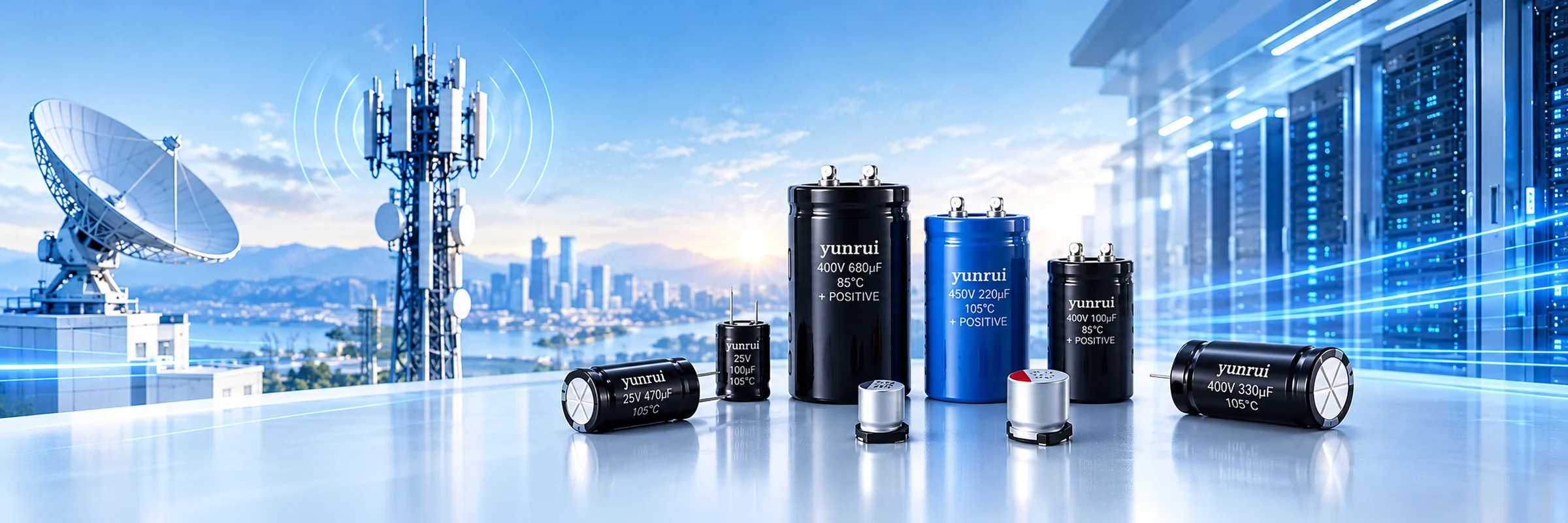
Application Sector
Capacitor Solutions for Telecommunications
Telecom and networking equipment runs continuously. Rectifiers and shelf power supplies convert mains into intermediate DC rails, and boards then take those rails through local DC-DC conversion to the voltages the processors, line interfaces and RF stages actually use.
Because nothing ever switches off, two things matter more than peak capability: how parameters drift over years of continuous operation, and how much ripple current the parts absorb in conversion stages that are loaded all the time.
This is the sector where the Yunrui catalogue is most explicit about end equipment. It names particular series for DC-DC converters, voltage regulators, motherboards, servers, adapters and switching power supplies, and those statements are the basis for the series listed below.
Design challenges
Application Challenges in Telecommunications
Continuous operation turns these five into long-term selection problems.
Years of uninterrupted duty
Equipment is expected to run continuously, so an endurance figure has to be read against a duty profile that never rests rather than against a nominal test.
Ripple current in conversion stages
Board-level DC-DC converters load their input and output capacitors continuously, and the resulting internal heating feeds back into local board temperature.
High-density boards
Network boards pack tall components close together, and airflow across parts deep inside a chassis is limited, so local hotspots are common.
Low ESR requirements
Modern point-of-load converters and fast digital loads expect low ESR and low impedance across frequency, not just a large capacitance value.
Cost of field replacement
Replacing a part in installed infrastructure costs far more than the part, so lifetime and stability are economic parameters as well as technical ones.
Selection dimensions
Capacitor Requirements for Telecommunications
For telecom work the weighting shifts towards ESR, impedance and endurance at board temperature.
ESR and impedance behaviour
Check ESR and impedance at the switching frequency of the converter and across the temperature range, since the nominal value is rarely the worst case.
Ripple current rating
Confirm the ripple rating for the actual position, including how ripple distributes between parallel parts with different ESR.
Operating temperature at the part
Derive the requirement from board-level thermal behaviour in the populated chassis, including the effect of neighbouring heat sources.
Endurance under continuous duty
Compare endurance with the intended in-service period, remembering that a continuously energised part accumulates hours quickly.
Intermediate rail voltage
Size the rating for the intermediate DC rail including its tolerance and any planned variation of the input source.
Mounting format
Board-level polymer parts are typically radial; the same functional positions on the supply side often use radial aluminum electrolytic parts on the PSU board.
Layer A and B
Recommended Product Types
Recommendations below are given on two levels, with series named only where the catalogue statement supports the mapping.
Conductive polymer aluminum solid capacitors
Used in board-level conversion and decoupling positions where low ESR and stable impedance over frequency are the deciding factors.
Radial aluminum electrolytic capacitors
Used on power supply boards and intermediate rail positions where higher capacitance values and higher ripple ratings per unit cost are required.
Relevant series
The polymer series below are named by the catalogue for the exact equipment categories this sector uses; the electrolytic series are named for the supply circuits powering them.
RS Series
The catalogue names this low ESR, high ripple series for DC-DC converters, voltage regulators, motherboards, servers and VGA cards. That statement covers the board-level conversion positions described above.
RL Series
Catalogue states long duration electronic devices, motherboards, servers, VGA and adapters, with 5,000 hours endurance at 105 degC. Relevant where continuous operation is the design premise.
GPS Series
Catalogue names this high-frequency, low-impedance series for switching power, UPS and adapter circuits, which is where telecom power supplies sit.
GS-T2 Series
Standard series carrying the same catalogue statement for switching power, UPS and adapter circuits, covering a wider rated voltage range.
RH Series
Verified for operation to +125 degC and described in the catalogue as suited to increasing device reliability. May be considered for positions that run hot inside dense chassis designs.
No statement about network certification, carrier approval or telecom standard compliance is made on this page, because our catalogue documentation does not contain one.
Circuit positions
Typical Use Cases
Representative positions in telecom power and network equipment.
Rectifier and shelf power supply boards
Input and output positions of the AC-DC conversion that creates the intermediate DC rail, where the GPS and GS-T2 statements apply.
Board-level DC-DC conversion
Input and output positions of point-of-load converters feeding processors and line circuits.
Adapter and external supply output filtering
Output filtering stages named for the RL, GPS and GS-T2 series in the catalogue.
Decoupling of processor and interface rails
Positions where low ESR and impedance across frequency matter most, corresponding to the RS and RL statements.
Hot positions inside dense chassis
Where local board temperature is elevated and a higher temperature polymer may be considered.
Engineering checklist
Selection and Reliability Considerations
What to check before shortlisting a capacitor for this equipment class.
- Check ESR and impedance at the converter switching frequency, not only at 120 Hz.
- Compare ripple ratings at the actual operating temperature of the board.
- Confirm that the endurance figure reflects continuous, not intermittent, energisation.
- Review parameter drift expectations over the intended service period with the supplier before locking the design.
- Check height and lead pitch against the populated-board layout in a dense chassis.
- Final capacitor selection should be confirmed against the specific electrical, thermal and mechanical requirements of the application.
Next step
Relevant Products and Series
Published links into the product structure. Every link below goes to a live page.
Relevant product families
Relevant categories
Request for quotation
Need help selecting a capacitor for your application?
Tell us what the circuit actually needs and we will answer with comparable part options rather than a generic brochure.
- Application and equipment type
- Working voltage including excursions
- Required capacitance and ripple current
- Operating temperature at the capacitor position
- Required lifetime or service interval
- Mounting and board-space constraints
Guizhou Yunrui Electronic Technology Co., Ltd. was established in 2018 and operates a 68,000 m2 production facility with 300+ production lines, more than 4,000 product models, 25 intellectual property rights and a supply capacity of approximately 15 million pieces per day, under ISO 9001 and ISO 14001 certified systems.